
Open post

Farmers Beat Composers at this One Thing

If you’re like most composers, when you sit down at your desk or think about what you’re going to work on tomorrow, you probably think some variation of “It’s time to compose!”

You may get a little more specific, like “I need to write this passage” or “that movement” or “this cue.”

But generally that’s where it stops.

You leave it to your intuition to fill in the blanks of “what do I do next?”

Sometimes that works fine, but too often it leads us into an unnecessary panic of “Wait! I don’t actually know what I’m doing!”

Why farmers work smarter than composers

Consider the farmer.

They don’t wake up and say, “It’s time to farm!”

Even to those of us with minimal manual labor experience, that sounds silly.

Instead, the farmer has a clear routine:

  • Feed the pigs
  • Milk the cow
  • Let the chickens out of the coop
  • etc.

These are specific tasks.

They wake up. They know exactly what they have to do. They go do it.

They may be tired or have personal concerns, but they have no stress or worry over “What should I do next?”

But too often as composers, in our quest for originality and relevance, we grossly underplay just how repetitive our work actually is.

What composers can learn from farmers

👉 Here’s the secret: naming your composing tasks makes creativity easier and more fun.

Yes, I recognize that composing is a creative process.

True, this means that your work rarely comes in the order of “A, B, C, D, E, . . .” but more often looks like “11, C, 2, 3, D, E, X, 8, 4, nine, . . .”

But just because the ordering of these tasks is often nonlinear does not mean that the tasks themselves are not discrete and definable.

The composition equivalent to farm chores would be things like:

  • Draft this 8-bar melody
  • Devise 3 or 4 ways to harmonize it, then pick one
  • Brainstorm several different ways of arranging it for the ensemble
  • Execute that arrangement
  • etc.

Because of mental simulation, when you can identify what you’re trying to do, it makes it so much easier for your intuition/your inspiration/the muse/whatever-you-want-to-call it to do its work.

So here is my invitation to you today:

  1. List out the composing tasks you know how to do.
  2. When it comes time to compose, identify 1–3 specific tasks you want to accomplish

Again, having these tasks does not mean you must work rigidly or robotically.

But it will help you work smart, like the farmer, and not constantly second-guess yourself.

Open post

The Bell Curve Lies about Your Impact

As creators, whenever we share what matters to us, especially what we create, we feel vulnerable. Here’s a key principle that can help soften the blow.

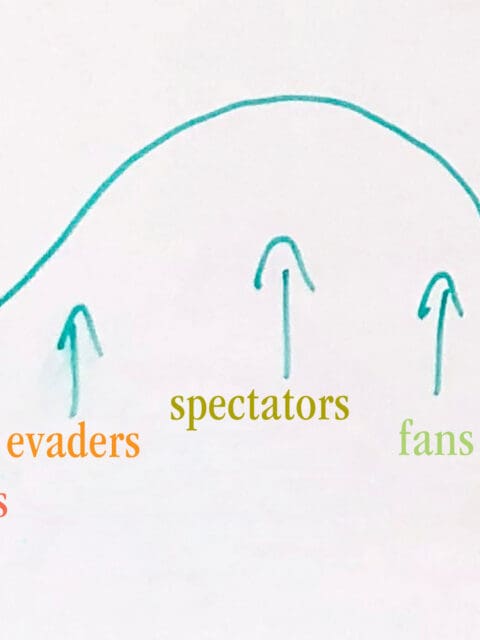
Whatever you share will receive a spectrum of responses — it's a classic bell curve.

This bell curve lies about the worth of your work.

Or, rather, if you misunderstand the bell curve, you will believe two big, disheartening lies rather than the one key, empowering truth.

Lie no. 1: Your work doesn’t matter because most people don’t care

At a glance, this is who you will see:

  • Most people will do little or nothing about it (the Spectators).
  • A slightly smaller group will acknowledge it but push it away, often passive-aggressively (the Evaders).
  • An even smaller minority will hate and criticize it (the Unbelievers).

Taken together, that’s most of the people.

But REMEMBER: they are not the real audience for what you create. Rather —

  • Another smaller group looks forward to everything you share (the Fans)
  • And an even more select group doesn’t just relish your work, but supports and promotes it (the Advocates)

THESE people — your Fans and Advocates — are those for whom you create.

As your audience grows, this bell curve grows along with it.

Lie no. 2: You can escape the bell curve

REMEMBER: as your audience grows, the bell curve grows along with it.

So even if your work becomes well-known, your Fans and Advocates will always be in the minority of the people who know about it.

No matter how big you are, if you survey your work’s aggregate response, it will always feel like your work is being ignored or even opposed.

With the scales eternally tipped toward apathetic-to-negative, it’s tempting to feel like your Fans and Advocates don’t count.

Truth: Your Fans and Advocates are hungry for your work

So most of all, REMEMBER: Your work is NOT up for popular vote.

You KNOW your Fans and Advocates treasure your work.

So shun the Unbelievers. Slough the Evaders. Ignore the inaction of the Spectators.

You only need to worry about how well you serve your Fans and Advocates.

Because, as Seth Godin says, they will miss you when you’re gone.

Open post

Own Your Voice: Workshop Replay (8/31/21)

In the above replay, we discuss:

  • How Artistic Voice is bigger than “style” or “technique”
  • The four parts of an Artistic Voice — “The Chorale of the Empowered Composer”
    • Stories (the “Soprano”)
    • Process (the “Alto”)
    • Technique (the “Tenor”)
    • Relationships (the “Bass”)
  • The typical reasons composers do NOT own their voice, but rather hide . . .
    • The “Frustrated Visionary” Composer
    • The “Lost in the Wilderness” Composer
    • The “Self-Censoring” Composer
    • The “Self-Sabotaging” Composer
  • Key Takeaways
  • The Career Success Spell Book (see below)
  • Q+A

How Can I Make the Career of My Dreams?

Let’s face it: music school focuses a TON on how to write music, but very little on how to make a career with your compositions. The 1-Day “Career Success Spell Book” Intensive Workshop is here to fix that. Click below to learn more about how you can have the career of your dreams.

Open post

Musical Variation Is Like a Good Set of Kitchen Knives

Variation in music is like having a good set of kitchen knives.

  • If you use them properly, cooking becomes easy and fun . . .
  • If you use them carelessly, somebody loses a finger . . .

Likewise, in composing music, variation is NOT inherently valuable.

How you use it makes the difference between

  • Giving your audience goosebumps . . .
  • Or making them fidget, cough, and check their watch . . .

Less deadly to be sure, but still deeply disappointing.

To use another cooking metaphor, wantonly adding variation to your music is like using too much salt — it makes your audience want to spit it out.

In short, musical variation is essential, but it is NOT inherently valuable.

(Photo credit: flickr.com/photos/stijnnieuwendijk/)

Open post

Speak Your Musical Truth

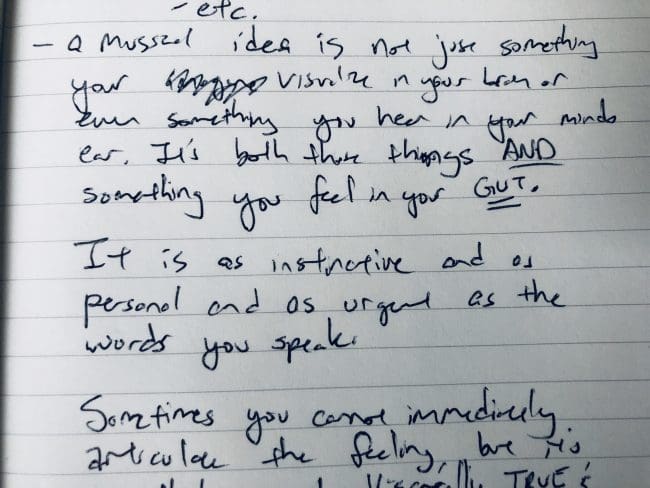
A musical idea is not just something you visualize in your brain or even something you hear in your mind’s ear. It is both those things and more.

It is most of all something you feel in your GUT.

It is as instinctive and as personal and as urgent as the words you speak.

Sometimes you cannot immediately articulate that gut-level feeling, but it is nonetheless real, viscerally TRUE — waiting for you to give it its fullest expression, whether in words or in music.

For this reason, questions about “clichés” and “originality” and “groundbreaking-ness” are utterly beside the point.

When you speak your musical truth from your heart, what else matters?

Open post

Preview: Violin Concerto

David Dzubay leads the BMCO with John Shin, soloist. (And I’m the one seated on the floor.)

At the end of my time at Brevard, I (along with the other composers) got to have a reading session with the Brevard Music Center Orchestra. The orchestra played the first two minutes of my new violin concerto that premieres December 7 at BYU. Jared Starr will be playing the solo part this December, but for the reading, it was played by another talented violinist, John Shin.

To the left is a shot of the session (courtesy Annika Socolofsky).

In the meantime, I now have to finish the piece in a month. It’s gonna be an <euphemism>exciting</euphemism> time for sure. That said, I am pleased with how the piece is progressing. Unlike my Barlow commission, this violin concerto is actually enjoyable to write. Perhaps that will take the edge off of the coming 14-hour days. Needless to say, you probably won’t hear from me till it’s over . . .

Anyway, here’s the recording from the session. Enjoy!

Countdown to San Francisco: 14 days

About a year ago, Eric Hansen and I talked about my writing him a chamber piece with the tentative title Book of Imaginary Beings. One year and a Barlow commission later, we held our first rehearsal of the piece—now titled A Field Guide to Natural History—in E251 of the Harris Fine Arts Center. The piece premieres two weeks from today at the 2011 convention of the International Society of Bassists in San Francisco.

Before I report on the awesome work Eric Hansen and the gang are up to, I thought I’d post some facts on the work itself and the compositional process.

By the numbers

  • 4 composers with whom I had lessons about the piece: Julian Anderson, Mark Applebaum, Stephen Jones, and Neil Thornock
  • 4 parts, namely saxophone, bass, piano, and percussion
  • 8 months, the time I spent working on it
  • 9 “deleted scenes”—or rather, movements that didn’t make the final cut
  • 10 movements in its final version
  • 13 percussion instruments used, namely agogo bells, 2 bongos, glockenspiel, suspended cymbal, tam-tam, 3 tom-toms, triangle, vibraphone, and 2 wood blocks
  • 20 minutes, the approximate duration of the piece
  • 31 pages, the length of the score
  • 43, the number of alternate titles I tried

The cover image for the score comes from E.H. Aitken’s 1905 book, A Naturalist on the Prowl.

More Trivia

  • The saxophone part was intended for Skyler Murray, who had asked me to write a piece for him after hearing my Clarinet Sonata. When Bill Gates nabbed Skyler for a summer internship, Dave Kjar jumped in to play the part instead.
  • The eight months it took to write Field Guide are the longest uninterrupted stretch of time I’ve spent on a single composition. Although my Clarinet Sonata took longer, I took breaks between writing its movements whereas I didn’t in writing Field Guide.
  • To date, this has been my most difficult piece for me to write. Part of the challenge stemmed from the ensemble. Although sax, bass, piano, and percussion lend themselves well to jazz writing, in a more classical context, these instruments are an unwieldy combination just to create a sense of ensemble unity. The combination also doesn’t do well with a linear musical narrative (e.g., Mozart), so instead I had to fill the twenty minute span with nearly fifty jump cuts between blocks of material (e.g., Stravinsky).

To be continued . . .

Patting Your Head . . .

Today I wrote music . . . while listening to other music. Though a first for me, this isn’t too unusual. One of my friends routinely writes music at concerts; my teacher admitted to writing one of his best pieces will at a friend’s recital; and I’ve even heard rumors that Luciano Berio wrote his Folk Songs while watching TV.

Gonzo and Fozzie demonstrate their skills at patting their heads and rubbing their stomachs in the dark room scene of The Great Muppet Caper.

Yet up until now, the idea of writing while listening to something else seemed weird to me, like simultaneously patting your head and rubbing your stomach. How could you write music and listen to different music at the same time? Writers certainly can’t do it. Imagine trying to write an essay while simultaneously reading Dickens. Though artists look at external objects all the time while they’re painting and drawing, they usually look at their subject, not, say, at a Jackson Pollack while painting a landscape. Why then does composition allow this unique multitasking?

I think it has something to do with the way our minds process music. Everyone is familiar with what it’s like to get songs stuck in their head. To non-musicians, it seems natural that composing an extension of this process. Composers simply listen to the music inside their heads and write it down. While many composers do say they write that way, if taking dictation from their earworms were all they were doing, it would seem to be as difficult for a composer to write music while listening to it as it would be for a writer to write while reading.

Instead, as I was composing today, I noticed that I was using multiple facilities. With one part of my brain and with my body I was processing the music I was listening to, and with another part of my brain, I was composing. The part that was composing wasn’t imagining sounds aurally but by feel. It was paying attention to what the harmonic and rhythmic relationships felt like rather than what they sounded like. After this experience, I happened to run into my aforementioned friend who confirmed that he experienced simultaneous listening and writing the same way.

What does this all mean? I’m not quite sure yet, only that composing is now more mysterious tonight than it was when I woke up this morning.

Pre-composition and Football

Whenever people find out I’m a composer, they first ask, “What kind of music do you write?”  for which I have yet to come up with a good answer. “Instrumental” and “classical-ish” are my usual responses. The next comment they make is often “I could never write music.”

From what I can tell, many people are under the impression that music just “happens,” like falling in love Disney-style or catching a cold. Zapped by inspiration or transported by emotion, the composer pours out his soul over the keyboard, and soon a new piece of music is born. Not so. For all you who feel they could never write music, I hope to demystify the process somewhat. And to help you understand this, let’s talk about football.

A football team would never dream of walking onto the field and hoping that winning plays would just “come to them.” (Image from directsnapfootball.com)

Next Saturday, BYU will kick off its football season against Washington in what will likely be an emotional rematch, after an excessive celebration call lost Washington the game two years ago. (I’m excited for this year’s game and season!) Now, no one expects that either team will show up on the field without any preparation, physical or strategic. Particularly with strategy, the last thing a football team would dream of doing would be walking onto the field and hoping that winning plays would just “come to them.” So, plays are created and drilled in advance. Their application in the game is flexible, but their existence allows both teams to better meet the demands they’ll face.

Likewise, when I begin a piece, I have dozens of options about how to organize the melodies in the piece—when to present which one, for how long, in what key, and so on. Awareness of all these options means I can’t just plop down at the piano and let the music mystically “flow through me.” Like a football team preparing for a game, I have to make many decisions in advance. Though my compositional “game plans” are often technical (and thus obtuse to most people), there’s nothing mystical about them. After establishing the piece’s rhetorical situation and my performers’ abilities, I identify the technical means suited the situation (the length of the piece, its textures, harmonies, etc.) and choose from among them.

Once made, these decisions—my pre-compositional game plan—give me the tools necessary to fill the needs of the music I write. If I become puzzled about a particular melody or harmony, my game plan will suggest ways to resolve the conundrum. Sometimes it works the other way, too, and melodies suggest ways of enriching the game plan. Again, this is like football. Having planned plays can answer the question of how to get out of tight spots, but observing what the other team is doing—for instance, always throwing to the left or something—can also suggest ways of enriching a team’s strategy.

The moral of the story is, if you understand how the creative process works in football, you understand pretty well by analogy how it works in music. Or at least how it works for me.

Posts navigation

1 2 3
Scroll to top