
Open post

Inherent Vice — in Music

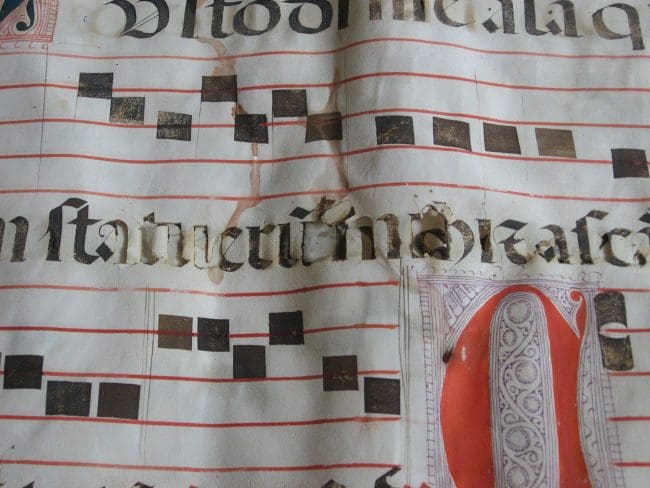
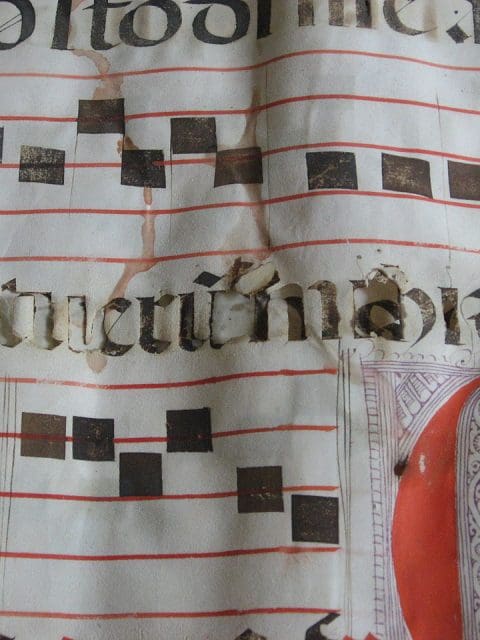
The ink erosion in this chant manuscript is an example of inherent vice.

“Inherent vice,” says Wikipedia, “is the tendency in physical objects to deteriorate because of the fundamental instability of the components of which they are made, as opposed to deterioration caused by external forces.”

As a property of physical objects, this is why certain papers and films last longer than others. It also is why materials deteriorate the way they do.

But what interests me about inherent vice are its potential musical analogies. Here a few examples of how inherent vice can be recreated in music.

Fred Rzewski: Les Moutons de Panurge

Rzewski makes it easy for performers to get lost, and in the score, he explicitly directs the performers that “if you get lost, stay lost. Do not try to find your way back into the fold.” The analogy to inherent vice is pretty clear: the piece will fall apart. What’s fascinating though is how Rzewski repurposes this as a virtue. Thus, the title feels to me like a humorous reference to Isaiah 53:6: “All we like sheep have gone astray.” (To my ears, there is no obvious reference to Handel’s setting in Rzewski’s piece, other than a general, wandering melodic contour.)

Alvin Lucier: I Am Sitting in a Room

As with Rzewski’s piece, the inherent vice of Lucier’s musical-acoustic scenario is the desired outcome. Here, the vice comes not from confusing the musicians, but from harnessing the result of rerecording the same speech, repeatedly, which gradually washes out the speakers voice and reveals the acoustic resonance of the room in which it is performed. The overall process and result feels like a metaphor for merging with the universe and reminds me of the Buddhist doctrine of anattā.

Michael Gordon: Gotham, Part III

The third part of Michael Gordon’s Gotham undergoes a similar process, albeit composed out and for orchestra. I find fascinating the different textures that he teases out of having the violins initial line unravel. Inasmuch as the process is composed out, rather than a result of the score’s execution, I wouldn’t consider the vice here to be as “inherent” as Rzewski’s or Lucier’s pieces. It’s more like “predestinated vice”: the composer decided the piece would gradually fall apart, so he ensured that it happens.
Open post

Movement is the soul of music

yoko-kanno
Yoko Kanno

Of all my artistic influences, musical and otherwise, the most impactful has been Yoko Kanno’s soundtrack for the anime series “Cowboy Bebop.” At first listen, Kanno’s music is striking for its stylistic variety. Although jazz forms the core of the music, it branches out to blues, country, rock, heavy metal, and even late Romantic opera. Yet underpinning this seeming hodgepodge is a unified rhythmic sense. In every style, Kanno nurtures a rich ecology of rhythmic relationships. The music moves and flows in complementary streams, and that harmonious interpenetration resonates to the core of my musical aspirations.

In technical terms, what I’m feeling are its polyrhythmic grooves, the meaning those grooves create for surface syncopation, and the sheer energy all this movement generates. More artistically, this music affirms that, for me, movement is the soul of music, that music is first a corporeal — rather than merely aural or intellectual — experience, and that, because it increases awareness of both your physical existence and your interconnectedness, music is fundamentally a celebration of life, a religious experience.

Now “Cowboy Bebop” doesn’t have the only music in which I hear this textural richness. I’m attracted to it as well, for instance, in the music of Anton Bruckner, Elliott Carter, John Williams, Stevie Wonder, and, of course, J. S. Bach. But though I value that music, too, I always return to Kanno’s work as a touchstone for the feeling of life that I want my music to carry.

Open post

Music of our Time

Stumbled across the following in an article about teaching jazz within an historical context:

A musician, even a great one, has far less control over the general course of his art than we might think. The broad outlines of a style, it seems clear, are shaped by ideas in society. Thus, a player like (Marion) Brown (who claims to have no outside influences) cannot escape tapping into the social currents of his time, and if enough listeners hear those currents in his playing they ate just as ‘right’ about his music as he is.

Food for thought as I continue to refine what I mean to do and be as a composer.

Now, a self-conscious composer could ask, “What are the ideas of our times?” But what Harker implies in this passage is that you don’t have to go looking for those influences. You don’t have to play journalist or historian or pundit for the times to speak through your music. They’re already in you. They don’t take any special reflection to reveal themselves.

Thoughts?

Open post

Artsy Guitar Hero

I’ve written in the past about James Tenney’s Meta-Hodos, on this blog and for school.

(Fast summary: According to Tenney, just as we usually divide time into years, months, days, and so on, music can be divided hierarchically. This hierarchies arise in music because of musical differences from moment to moment (and phrase to phrase, section to section, etc.). The shapes of these differences — and the similarities that bind sections together — are how form emerges.)

Today I found a great piece that demonstrates this kind of thinking: Psappha by Iannis Xenakis. The most obvious of the hierarchies is created by the different percussion sounds, but you can also hear groupings emerge due to the different rate of events and the pauses between them.

For the truly nerdy, you can go read my paper and delve more into how this works.

Otherwise, you can just enjoy the cool sounds of an artsy Guitar Hero (ht: Josh Harris).

Open post

My Favorite Piano Concerti

. . . prompted by discovering I had a recording of Schumann’s Piano Concerto, op. 54, on my computer. So, in chronological order:

1. Robert Schumann — Piano Concerto, op. 54 (1845)

I love the first movement of this concerto. Growing up, the public library a series of videos about the orchestra featuring the Schleswig-Holsetein Festival Orchestra and Sir Georg Solti with Dudley Moore as narrator. Turns out Dudley Moore is also a fine amateur pianist. He played the solo part of this concerto in those videos, which is where I first really got to know it.

As it turns out, most of the rest of my favorites were written in a roughly 10-year span:

2. Erich Korngold — Piano Concerto for the Left Hand (1923)

I don’t know how I found this piece first, but I love so much about it: the harmony, the viscerality of it, the way the vigorous sections are contrasted with ethereal ones, and how it all flows together in one continuous movement.

http://www.youtube.com/watch?v=irpieq0G0eI

3. George Gershwin — Piano Concerto in F (1925)

How can anyone not like Gershwin? Enough said.

4 and 5. Maurice Ravel — Piano Concerto in G (1931) and Piano Concerto for the Left Hand (1930)

Ravel’s two concerti are the holy grail of concerto writing for me. They’re very contrasting works. The Left-Hand Concerto is dark and profound whereas the Concerto in G is light and winsome. The Concerto in G also contains 9 of some of the most beautiful minutes of music ever in the Adagio Assai.

6. Sergei Rachmaninov — Rhapsody on a Theme of Paganini (1934)

I heard lots of Rachmaninov ever since I was a kid, but out of all of the concerti, this one is my favorite (followed by 3 and 4 in that order). I love the variety of moods and colors. As with the Ravel and Korngold concertos for the left hand, Rachmaninov does a great job pulling along the narrative without a movement break. [Note—For the video below, I found a really good remastering of Rachmaninov himself at the piano.]

And, finally,

7. Dmitri Shostakovich — Piano Concerto no. 2 (1957)

In some ways, I hear this concerto as companion piece to the Ravel Concerto in G. They have a similar arch to them except that the Shostakovich is darker and more visceral. [In the same spirit as the Rachmaninov above, I’ve included the composer’s own rendition below, though you’ll have to follow the links in the comments to movements 2 and 3 for this one.]

So, yeah, “no Mozart, Beethoven, Chopin, Liszt, or Brahms”? Nope. And no apologies — but you can write your own list, if you like . . .

Open post

What Goes Through My Ears While Composing

Thank goodness nothing literally.

I like to have “reference” music while composing. It usually has nothing to do with the music I’m writing. In fact, I’m actually not quite show what relationship it has to what I end up writing, except that I like having some consistency to what I listen to. Here’re some highlights from the playlist for the quartet I’m working on, including a surprisingly good recording of the Finale of Bartók’s Concerto for Orchestra.

By the way, this quartet I’m working on has to be done by tomorrow. So if you’ll excuse me . . .

Open post

The World’s Ugliest Music? Nice Try . . .

So Dr. Scott Rickard thinks he’s composed the world’s ugliest music using fancy math.  I’m not convinced, but you can hear for yourself: the piece, written for piano, starts at 7’48.

Rickard is not the only one to use fancy math to write music. Most notably, Iannis Xenakis beat him to the punch nearly sixty years ago. Nor is it the only piece to rely on chaos to make itself unpredictable. Alvin Lucier’s  “Music on a Long Thin Wire” does that pretty well, too. In both Xenakis and Lucier, there’s an elemental beauty I find attractive (even though I wouldn’t want to listen solely to their work), and Rickard’s new work, I would argue, fits in that vein—that is, making music out of non-musical processes.

Concerning Rickard’s “pattern-free” claim, that’s certainly true if you’re looking for motives, but Mr. Rickard clearly hasn’t read Meta-Hodos (in addition, at 6’12, to misrepresenting Schoenberg’s motivation in creating the twelve-tone method. Fail.). Try as he might, he can’t de-musical-ize music. As Tenney explains, because Rickard’s materials are differentiated, relationships inevitably emerge. The most simple of these inadvertent relationships is agogic accent. While the piano piece has no definitive melodic cadences, it does have clear clusters of events, the boundaries of which are determined by the longest note in a local area. To my ears, it sounds like a series of elided phrases. Another set of relationships emerges because of the clear differentiation of registers. Particularly at the extremes of register, you hear a sense of interrupted continuity. The notes group themselves because they sound similar with respect to pitch-height. To put it simply, “random notes” can never sound random.

That said, even though I hear musical patterns within the texture, I don’t think these relationships are nearly as important as the overall sweep of the piece—in the same way that, although you can segment a performance of “Music on a Long Thin Wire,” the segmentation of it isn’t really the point. In fact, I would say that Rickard was actually quite successful in creating a work in the “acoustical positivist” vein. In both the Lucier and the Rickard, the sum texture, incorporating all internal variation, is the music. What makes such works beautiful is that even though they are, in effect, static objects, you don’t experience them statically. Only on reflection do you realize, “Wait, this is all of a whole.” There’s a serenity to such music that’s quite similar to listening to a stream or the wind (a comparison that, if I remember correctly, Lucier himself makes).

Now, if you really want to write an ugly piece of music, your best bet is to go the route of tedium. The careful use of repetition gives you a far better foundation with which to defy expectations and create a perpetual sense of anticlimax. Throw in some bad voice-leading and gratuitous dissonance, and you’re on your way. Incidentally, another group of scientists did something like this, although they approached the effect on a tangent.

Also incidentally, I really need to go to bed. So good night.

Scroll to top