
Open post
Correction-covered page

What I Learned from Quitting Music

I’d had it with music.

Composing was too hard, too frustrating.

I couldn’t figure out how to get the sounds I heard into my head onto the paper. Worse—I wasn’t even sure if I should put those sounds to paper.

So I became an editor.

Or rather, I added the editing minor to my undergrad degree.

And it was the best choice I ever made for my music.

At the time, the main professors in BYU’s editing minor were Mel Thorne and Marvin Gardner. Now retired, both men even at that time belonged to a group I affectionately considered ”The Greatest Grandpas of Utah Valley.”

Mel’s background was in academic and book publishing. He was more down-to-earth and task-oriented.

Marvin’s background was in magazine publishing. He was more effusive and gentle.

Both were consummate professionals and unflaggingly generous in the mentorship they gave to their students.

After multiple classes from both professors and an internship with Mel, I came away with a transformed view of writing and editing.

Up until that point, like most of us, I dreaded getting my English papers back drenched in red from all the corrections teachers would put on them.

I associated writing with “being graded” and editing with “the person doing the grading.”

Mel and Marvin utterly transformed how I understood this relationship.

They showed me that, in the professional world, editors and writers are allies, not adversaries. The goal is for the team to complete the task well and efficiently—not any one individual.

Writers who insist on polishing their writing to perfection before sharing don’t just waste everyone’s time, they act defensively in bad faith.

The whole purpose of having an editor is so that the writer doesn’t have to get everything right at first. The editor-writer team can produce better prose faster when they work together than when the writer tries to make everything perfect first.

When I understood that my job as a writer was simply to get my ideas on the page, not to perfect them, that liberated me.

Even if I hadn’t fully articulated my ideas. Even if I couldn’t yet fully understand them. I knew, “The editor will help me fix this!” (Editors are a lot like therapists, helping you articulate the things you feel but don’t yet understand.)

I saw that my job was simply to give the editor something to work with.

This point was hammered home last week during office hours in the Wizarding School for Composers.

One of my students, Joseph Fletcher, shared the “two rules of creativity” he had come to understand from our work this semester:

  1. “Don’t be afraid of a half-baked idea.”
  2. “Don’t settle for the half-baked idea.”

Rule One describes the writer’s role. Rule Two describes the editor’s.

As creatives, we often struggle with accepting the validity of both roles.

In Joseph’s case, he explained, “I think I’ve been in Rule Two for a long time, but I haven’t been very good at Rule One. I just mull and mull, so my progress is slow. My willingness to just throw something at the page and then start iterating from there—that’s the thing in my process I’m hoping to adapt.”

Many others have the opposite problem: They’ll gladly generate and generate, but when it comes time to refine their ideas, they struggle.

But knowing that these two roles exist and can work in harmony is half the battle.

It didn’t just make writing prose easier and more joyful for me, it did the same for my music. And it can do the same for yours.

Which role, editor or writer, do you relate to more?

(Photo: Nic McPhee/Flickr)
Open post

How Chess Captures the Essence of Why Composing Is Hard

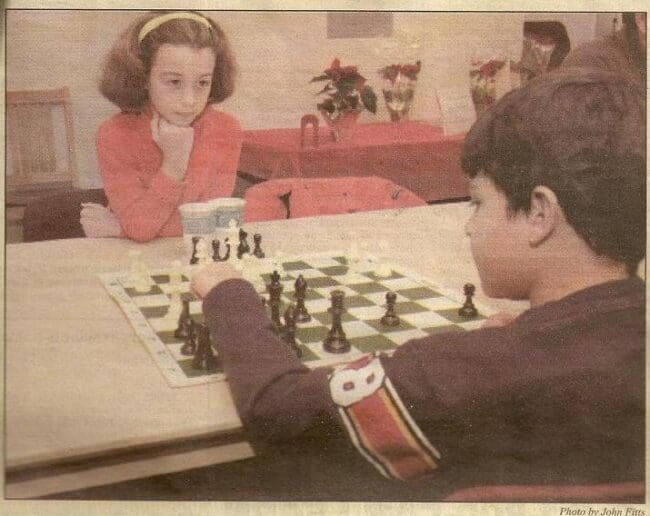
When I was in elementary school, my siblings and I went to the chess club at our local library. 

(This was back when playing chess would make you a “nerd.” Or, at least, back when I might have cared about being called a nerd.)

Chess club solidified my hazy idea of what all the pieces did. It also taught me a few fancy moves like “en passant” and “castling.” Best of all, we had pizza at every meeting.

My time in chess club ended when I moved up to middle school. I had fun, but I was no Bobby Fischer. Chess.com still pegs my Elo rating at 859 (novice).

If only mastering chess were as easy as going to chess club (and eating pizza)!

The first challenge of chess is learning how the pieces move. It can be a lot to remember starting out.

Once you’ve mastered those moves, the bigger challenge is coordinating a larger strategy.

For a long time after chess club, I didn’t like playing chess, because it involved a lot of thinking ahead. I didn’t realize there were predictable patterns for the opening, mid-game, and end game moves. 

Since I had a limited understanding of good strategies and how to execute them, playing chess felt like guessing.

Composing music is just like this. 

Even a simple hymn harmonization encompasses a lot of details. 

You have to put in all this work to master chorale writing—the music theory equivalent of “learn how all the chess pieces move.”

Despite that work, mastering those skills doesn't really prepare you to coordinate a larger compositional strategy. Particularly when you learn, “Well, actually, in real music, the notes move a bunch of different ways in addition, or even in contradiction, to what you’ve be taught.”

It’s enough for any aspiring composer—and sometimes even professional composers—to throw up their hands and say, “I’m just going to stick with what I know!”

But, as in chess, in music there are patterns and principles that you can learn. You don’t always learn these in music school. Even when you do, they’re often delivered ad hoc and piecemeal.

This is why I created the Wizarding School for Composers: to collect all these strategies in one place so that other composers wouldn’t have to spend a decade-plus piecing them together like I did.

Open post

My Biggest Musical Embarrassment

I was mortified.

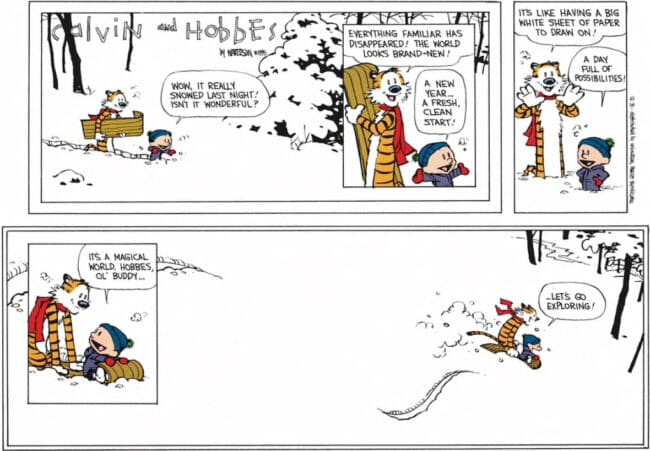
I had been invited to conduct my Calvin and Hobbes–inspired piece, “Go Exploring,” during a reading session of a visiting ensemble.

The musicians were struggling with the music I had written in general and with a certain 7/8 bar in particular. They had been rehearsing the piece without a conductor, and then called me in when the going got tough.

And boy did it ever get tough—on me!

I couldn’t conduct the passage in a way that helped them grasp what I was doing musically.

They eventually muddled through a credible rendition of it.

But I felt terrible about the piece I had written, even though the recording turned out okay. (My sweet composition teacher, David Sargent, even said, too: “The only thing I wish I could change about that piece was that I wrote it myself.”)

Too often when I was learning to compose, I found myself in situations like this: writing music that was needlessly difficult.

I wrote complicated music, because I didn’t know how elegantly to capture the magic of what I heard in my head.

That embarrassing reading session, more than any other event in my musical education, lit a fire in me to figure out how to express complex musical ideas simply.

There’s a good chance that you, too, are held back in your composing because of how complicated you perceive music to be.

  • You avoid composing because you don’t know how to create the complex sounds you hear.
  • You don’t believe your music is good enough because it doesn’t sound complex in your ears.
  • You think that vivid, sophisticated musical ideas aren’t for you because you’re “just a performer.”

Just know this:

The simplicity of your musical ideas isn’t a bug. It’s a feature.

You don’t need a massive vocabulary to create great music.

Although you may not know it yet, your original music is a gift that others will treasure.

Everyone is capable of making music that matters.

That includes you.

Open post

Have You Fallen into the “Technique Trap”?

As musicians, we learn a lot of technique in school. It’s what we’re graded on. It’s often what we value in others or ourselves. It can be easy to think that technique is the be-all, end-all.

At the very least, focusing on technique feels comfortable. It’s what we’re used to. It feels like something we can control.

But once we graduate to larger world—unless we’re one of the few who land the full-time orchestral gig or university teaching job—the reality is starkly different.

Professional careers require more than flawless technique. These demands can feel daunting to even the most talented and proficient musician:

  • How to find gigs and secure commissions
  • How to cultivate an audience for our work
  • How to create and execute projects that fulfill our artistic dreams and impact out communities
  • How to negotiate money and contract issues
  • . . . and on and on

These are difficult problems. 

Because of our training, our first instinct is often, “Let me throw more technique at these problems. That will get me the success I want!

Yet—hopefully sooner rather than later—we discover that, for these questions, technique is often a cop out:

  • An excuse not to show up by saying “I’m not ready.”
  • A defensive reaction when the audiences we inherit aren’t interested in our work: “They just don’t know quality when they hear it.”
  • A hurdle that maintains gatekeepers’ power by encouraging us to say, “I must not be good enough yet.”

Insecurity, cynicism, powerlessness—these are some heavy feelings.

But they are not the truth of your career or potential.

Your career is not constrained because you lack the technical mastery of Yo-Yo Ma or Augusta Read Thomas.

You can create the artistically fulfilling, socially satisfying, and financially rewarding career of your dreams—if you widen the scope of your artistic possibilities past technique.

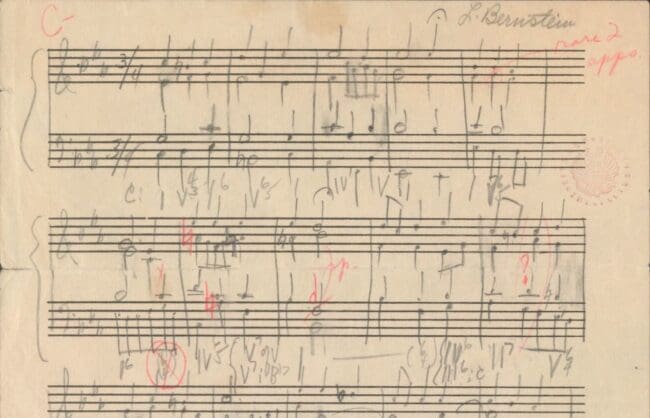
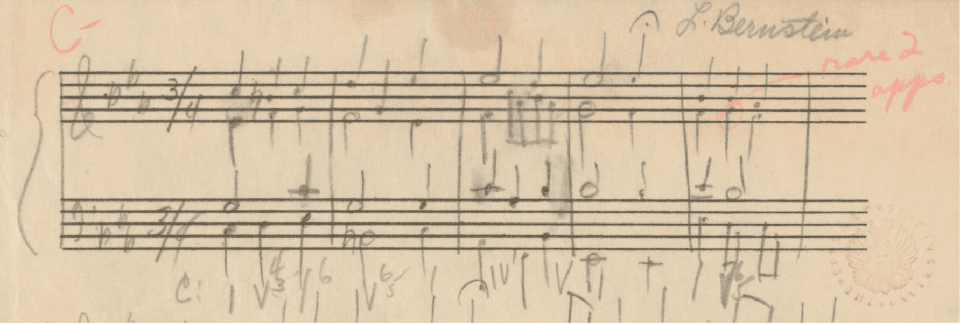
The image that started this post comes from the harmony assignments that Leonard Bernstein wrote while a student at Harvard . . .

He got a C-. But I don’t have to tell you who Leonard Bernstein is or what he did.

Just like Lenny, there’s more to your career than how good certain gatekeepers say your technique is—even if your technique has room for growth.

So if technique is only part, what does a complete musician look like?

The answer is what I call your Artistic Voice.

And I’ll be sharing more about it in the coming weeks . . .

Open post
Kitten hiding

Are You Hiding Beneath “Better”?

Some musicians constantly buy new gear, because they think it’ll make them a better musician.

Others constantly try to develop new skills, because they think theirs are not good enough.

And it’s true. Yours could probably use some growth.

Yet new gear and improved skills are just a security blanket.

Every day—

  • Someone who orchestrates worse than you gets commissioned to write an orchestra piece
  • Someone who’s worse at MIDI programming gets hired to do the TV show.
  • Someone who is worse at melody writing gets their show on Broadway.
  • Somebody worse at teaching or research gets academic tenure.
  • Someone whose music is “less imaginative” than yours wins the grant
  • Someone who is worse at web design converts more score sales from their website than you do.

You, too, don’t need to collect all the gear or master all the skills before you are worthy enough, talented enough, or smart enough to make a difference in the world.

Even without you learning anything more, your music is already valuable to someone.

Stop hiding.

Find that someone.

Open post
Cooking deep dish pizza

How Learning To Cook Is Like Composing Music

I love to cook. My favorite part is chopping vegetables and inhaling their aroma as they sauté on the stove.

When I was younger, and when I want to try something new, I would follow recipes.

Often, though, I simply mix together and season what I have on hand.

I can do this because I’ve been cooking for more than a decade. So I know—

  • What the various ingredients taste like.
  • How to cook them using different methods.
  • How their flavors combine together.

Now I’m no expert chef or even some Andrew Rea-level home chef (though I’ll gladly binge with Babish any day).

But I have developed a baseline level of discernment: the capacity to judge well in the absence of a recipe, formula, or rubric.

Developing discernment is one of the highest aspirations for chefs.

Discernment liberates your imagination. It helps you know in your gut what will be the effect of your instinctive actions. It frees you to create in moment and instills a quiet, playful confidence.

For those same reasons, it’s also one of the highest aspirations for composers.

But composers often have to develop this discernment despite the theory and composition training they’ve received. Traditional composition pedagogy is filled with superstitions (see my mentor David Rakowski’s catalog of buttstix).

Imagine, if when you were learning how to cook, you had peers and mentors insisting on things like:

  • “Your recipe can’t be any good because it has tomatoes in it. Tomatoes are so cliché.”
  • “Your recipe is too similar to others to be any good.”
  • “You’re not a real chef until you put your own spin on broiling.”
  • “Your food doesn’t count because you made it in your home for yourself rather than at a fancy restaurant for paying customers.”

Such superstitions about cooking ingredients and methods rightly seem stupid.

Superstitions are the opposite of discernment.

But in music, suckers fall for that drivel all. the. time.

I would know. As a composer, I fell hard for it for almost a decade.

This is why I created the Wizarding School for Composers—to help other composers and aspiring composers develop real discernment.

With that discernment, my students work with greater fluency and joy all while having greater clarity on what actually moves the needle in making their music vivid, sophisticated, and magical.

Open post
crumpled paper

Have You Ever Had “Right Note” Syndrome?

As composers, we all know that ideas, technique, and process are inseparable:

  • Ideas are the specific musical gestures we imagine.
  • Technique is what we have internalized—physically, aurally, and theoretically—about music in general.
  • Process is how we use that technique to bring our ideas to life.

When these three align, composing is a joy.

When they’re not, it sucks. And, stuck, you struggle to string one note after the last.

That “what comes next?” frustration is the worst.

It makes you feel stupid and stressed.

You begin to think that you’ve forgotten how to compose—and, sometimes, wonder if you ever knew how to compose to begin with.

There are many ways out of this writer’s block, but which exit strategy to choose depends on which creative ditch—or, in other words, which maladaptive creative process—you’ve fallen into.

One such maladaptive strategy is the “right note” syndrome.

It happens whenever there’s a gap between what you hear in your head and what you comprehend about it.

Because of that gap, you can begin to obsess over a particular note, chord, or rhythm. You will play or listen to it over and over again, trying but never able to get it “right.”

This process is maladaptive because it doubles down on the idea/technique/process imbalance rather than relieving it.

The basic cause of “right note syndrome” is that you are applying your technique too narrowly.

The most important unit of music is the phrase, not any note-level event. When you fixate on details, you lose sight of both the technical and artistic contexts that could validate your choices.

The cure is, first, to refocus your attention on the phrase itself—not its details:

  • What is this phrase doing?
  • What is its mood?
  • How does the detail in question fit into the bigger picture of this phrase? Of the larger phrase group?

These questions will naturally inspire others about your artistic inspiration, too:

  • What is this phrase expressing?
  • What about that feeling, image, or idea must the music capture in this phrase? What can be given to a different phrase?
  • How does this phrase fit into the bigger picture of your influences and ideas?

Often, these questions are sufficient to get you unstuck.

Open post

Why Should Anyone Care about Tonality?

Tonality is a musicological debate about style disguised as a theoretical debate about pitch organization.

Whether it's Schenker's arrogant, narrow nationalism or Tymoczko's generous, imaginative catholicism, the debate around what defines “tonality” is, at its core, a question of repertoire.

No one would argue that the music of Bach, Beethoven, or Brahms is not tonal. But what about William Byrd? Or Bull? Or, to go the other direction, Barber? Or Britten? To say nothing of Charlie Byrd or the Beatles?

Whether the music of these latter figures is tonal depends on who you ask. But whether it exhibits pitch organization is indisputable.

Hence, tonality is fundamentally a question about style, not pitch organization.

Style is a red herring for composers

Learning to distinguish “tonal” from “atonal,” “post-tonal,” “pre-tonal,” or “extended tonal” music carries about the same relevance as distinguishing between sub-genres of death metal. It’s not useless—but it doesn't describe really how the music works. It mostly just identifies its stylistic markers.

In other words, “tonality” is an elaborately justified label.

For composers who want to know how music works, such stylistic labels are a red herring. Style can tell you what combination of features will produce a particular “sound,” but they don’t actually show you how it works. As Charles Ives quipped, “What has sound got to do with music?”

Milton Babbitt affirmed Ives’s quip when he asserted, “Nothing gets old faster than a new sound.”

Lest you think this bias against “sound” is some avant-garde fetish: First, remember how much avant-garde composers focused on sonic innovation. Second, put Babbitt’s words in the mouth of any pop music agent or producer, and you’ll notice that they fit right at home there, too.

Old cell phones have a lot to say about how valuable your “new sounds” are. (Credit: flickr.com/photos/vaguelyartistic/)

Like cars and smartphones, the value of unique “sounds” quickly depreciates.

Style tells you little about musical excellence. Instead, it is a proxy for cultural power and relevance. Again, this is not a useless consideration—but it is, at best, tangential to the question of pitch organization.

Musicians can organize pitch in a lot of ways

In truth, “tonality” comprises a detailed collection of pitch strategies that musicians have used in various combinations and emphases. Many of these strategies carry over into music that exists at the edges or beyond the boundaries of what scholars consider “tonal.”

Among other concepts and approaches, they include assumptions about

  • octave equivalence
  • tuning and enharmonic equivalence
  • structural hierarchies
  • distinctions between consonance and dissonance
  • the qualities, spellings, and inversions of different intervals and chords
  • the functional equivalence of chord inversions
  • harmonic consistency
  • harmonic syntax via scale-degree function or hypermetrical placement
  • harmonic and voice-leading schemata
  • the usage of different scales
  • the prevalence of stepwise motion generally in melodic lines and strongly in harmonic voice leading
  • melodic shape via step progressions, rhythmic permutations, or hypermetrical placement
  • melodic structure via rhythmic motives, pitch motives, and pitch contours
  • the harmonic implications of all melodic lines
  • the functional distinction between the bass line and upper voices
  • degrees of formal articulation indicated by coordinated of harmonic and melodic gestures (i.e., cadences and pitch centricity)

Despite being almost 20 items long, this list is hardly an exhaustive catalog of pitch organization concepts and approaches. What distinguishes different styles is how they remix these principles.

Some pieces use many of these strategies. Others use only a subset of them. Still other pieces use different pitch strategies entirely.

Though many pieces contain all of these strategies, no single piece can be said to exemplify all of them.

Focus on the effect and interaction of choices, not their labels: What does Debussy’s music do to create its unique states of being?

Focus on the effect, not the label

Furthermore, none of these strategies or their applications is intrinsically “excellent” or “superior.” But noticing them allows musicians to hone their discernment about how specific pieces create the musical effects they do.

For instance:

  • How can Debussy get away with writing parallel fifths?
  • How does Beethoven write an hour-long symphony that isn’t boring?
  • How does Rachel Portman write an hour-long soundtrack that isn’t boring?
  • Why does Byrd’s counterpoint feel different than Bach’s and different again from Bartók’s?
  • How does Mahler give you goosebumps?
  • How does John Coltrane create the luminous sheen in his solos?

These questions do tell you something about style—but when you go beyond merely labeling these features to describing their relationships to key moments in a specific piece, that’s when you really start to understand how music works.

That’s when you can discern not just why Debussy’s style is different than Clara Schumann’s (for instance), but what the music is doing to create its unique states of being.

Thus, the most pertinent analytical question for composers is not “What style is this piece and why?” or even “What specific choices did x composer make?” but “What is the effect of these choices?”

P.S.—If you want to dig further into these questions, here are some key books to check out: Gjerdingen, Harrison, Huron, Straus, Tagg, Tymoczko.

Open post

Why, yes, even today I can write!

As I explained in my last post, when you say “I can’t write music today,” you’re probably not referring to an ability, but to an outcome or aspiration.

And you’re probably correct. As BJ Fogg explains, “you can only achieve aspirations and outcomes over time if you execute the right specific behaviors.”

So, you probably can’t compose today if by “compose” you mean something like:

  • “Write impressive, innovative music like taking dictation.”
  • Or “Wait to get started until I have the right ideas.”
  • Or “Complete and polish an entire passage—not just a few bars, let alone only one aspect of it.”

On most days, such aspirations are totally unrealistic even if your name is Miles Davis or Augusta Read Thomas.

This is why the key tool I teach in the Wizarding School for Composers is “Shrink the Frame.”

As a baseline, “Shrink the Frame” means

“Give yourself tasks you actually have a hope of accomplishing.”

More optimistically, it means

“Break composing down into tasks that are short, clear, and even fun.”

Or, in other words,

“Identify, practice, and celebrate the behaviors that lead to your desired outcomes and aspirations.”

But what would that look like on any given Tuesday? And how could it possibly help you achieve even your highest artistic aspirations?

Mountain Base Camp. (Source: https://commons.wikimedia.org/wiki/File:Mountain_base_camp.jpg)

How Do You Climb a Mountain?

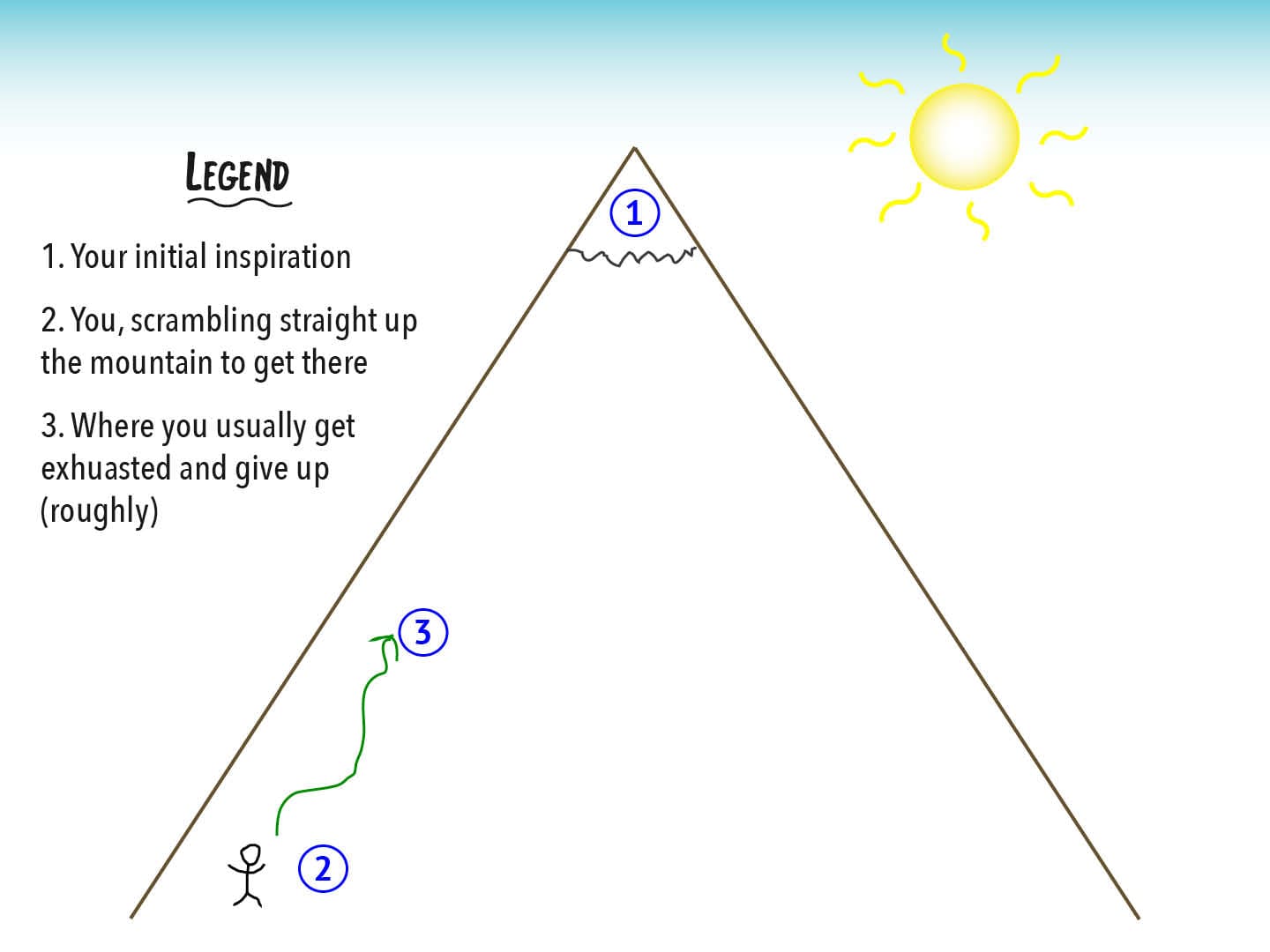
Imagine yourself about to climb a mountain. (I’m sure composing has felt like this for you at some point.)

Picture yourself standing there at the base, needing to figure out the fastest way up.

The first, tempting idea is to scramble straight up the face of the mountain. . . .

Anyone who’s hiked a mountain knows this is a dumb idea. You’d be exhausted before you made it even a third of the way up.

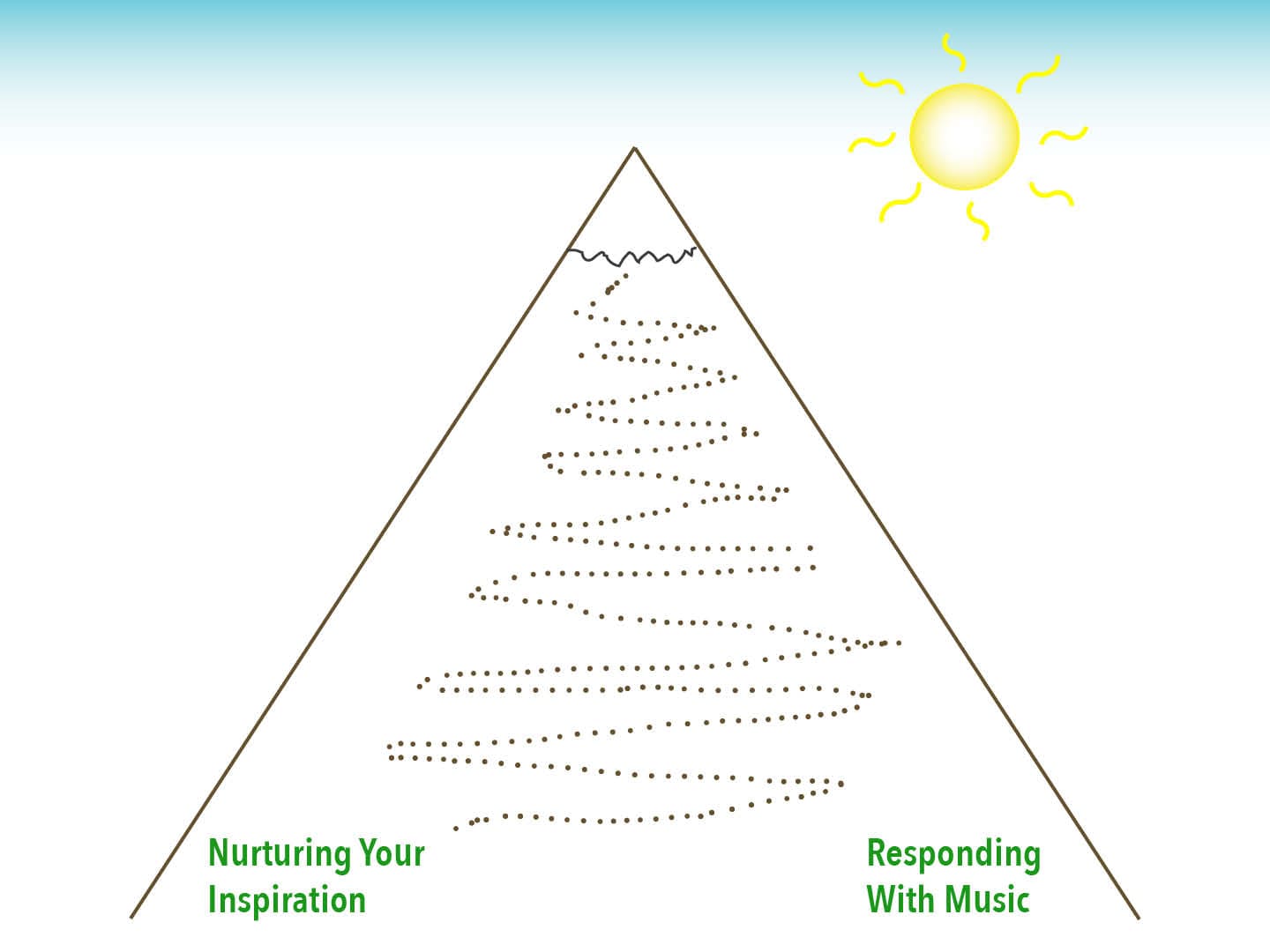
Instead, you look around for the trail and notice it consists of switchbacks, all the way up. Sure, this will still take effort. (After all, it’s still a mountain.) But you know you will have the energy and inspiration to keep going if you take this route instead.

So, wisely, you decide to take the switchback route.

Scrambling up the Mountain

The Scramble

Too often, that same wisdom does not carry over into composing.

At the start of each new piece, we typically catch some vision of what the completed work could be. That initial inspiration could be:

  • A song, piece, poem, novel, TV show, film, ballet, etc.
  • A story, experience, relationship, or memory
  • A musical fragment or something nonmusical
  • Even something as simple as a feeling or an intuition

Then, whatever the source, while that vision is still hazy but intoxicating, we attempt a mad scramble toward its summit.

This process hardly ever works. Its results are as predictable as they are unfortunate:

  • Your initial attempts do not get you anywhere close to completing the piece or capturing your vision.
  • Unable to move forward, your enthusiasm evaporates, and you end up in an emotional puddle.
  • You procrastinate until pressed against a hard deadline—then turn your life upside down as you rush to finish.
  • You learn to associate composing with anxiety, pressure, and massive expectations—making composing something you want to avoid.
  • You internalize the mantra “I work best under pressure,” though you secretly know this is just an excuse for your ineffective work habits.

Your ineffective work habits are not a moral failing. They are not a taint on your character.

But the truth is, you don’t work best under pressure. No one does.

There is a better way, and you can learn it.

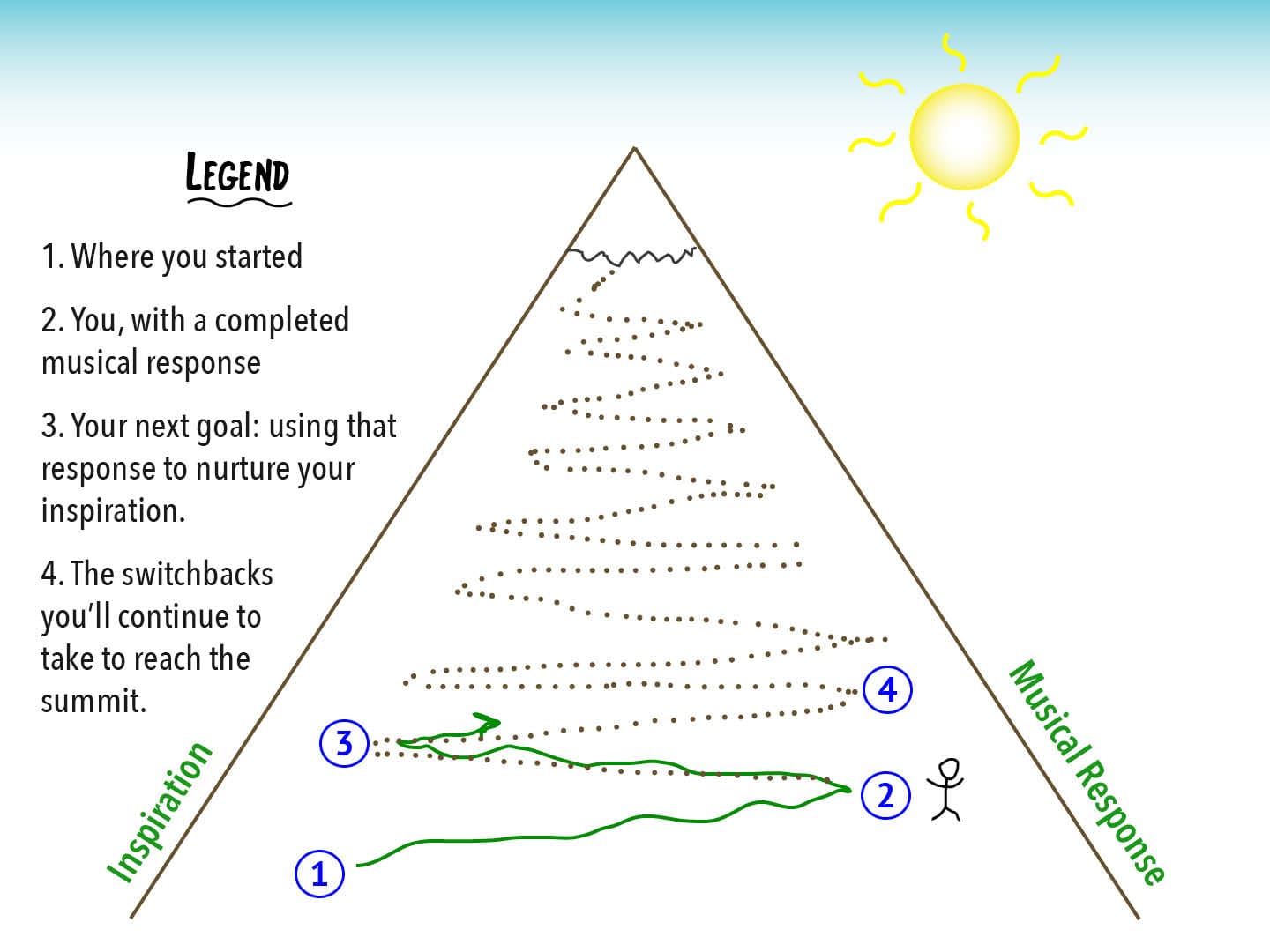
Switchbacks: nurturing your inspiration and responding with music

The Switchbacks: Your Initial Musical Response

Let’s go back to the start. You’ve just caught some vision of what the completed work could be. How can “switchbacking” help you proceed with a sense of ease—and even fun?

Imagine the two sides of the switchback represent two broad categories of action:

  1. Nurturing your inspiration
  2. Responding with music

Casting aside debilitating stories about the creative process, you don’t fixate on one big (but hazy) inspiration and make one massive push to get there.

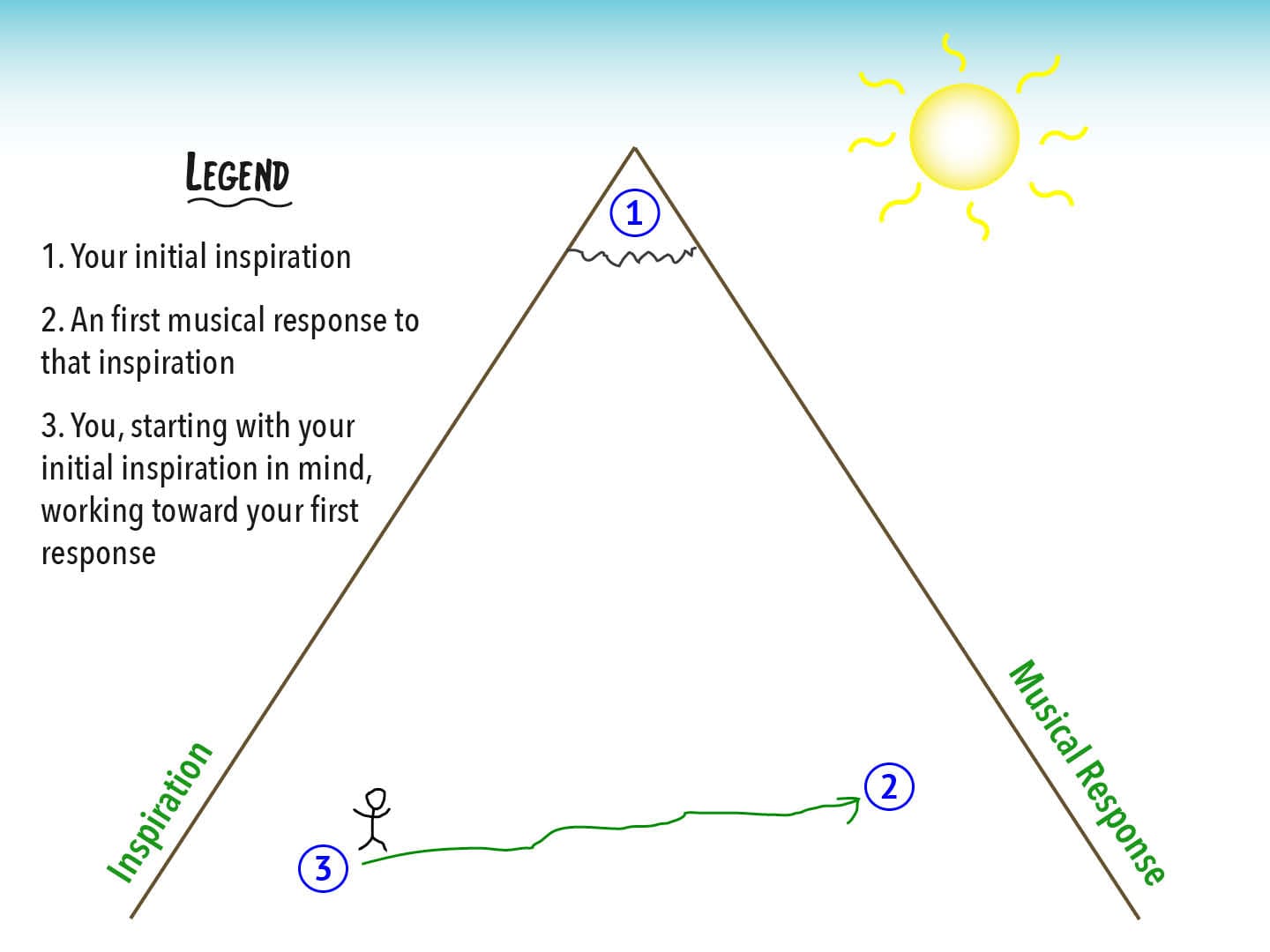
Instead, you

  1. Capture that initial inspiration in words, pictures, recordings, whatever.
  2. Create a small, initial musical response to your inspiration.

This response could entail you recording 3-5, minute-long improvisations. Or finding 12 chords that remind you of the inspiration. Or choosing which instruments would best capture its sound. etc.

Each one of these possible responses represent a single compositional task. You get credit for doing any and every one of them. All your work counts, even if it no one can see or hear it in the finished product.

First switchback

The Switchbacks: Nurturing Your Inspiration

There will come a point, however, when your initial inspiration runs out of steam.

This is not a threat.

You don’t need to fight it, flee it, or freeze (for instance, respectively: beat yourself up, go do the dishes/watch Netflix, or start taking quick, shallow breaths as you tighten all your muscles).

No, you are perfectly safe and just fine—you’ve simply come to the end of a switchback.

So now you simply need to start moving the other direction: use the music you’ve created to further nurture and refine your inspiration.

Go back to your notes or diagrams, and ask yourself:

  • Of the musical fragments I created, which best capture my initial inspiration? Why?
  • In what ways do these resonant fragments I created affirm my initial inspiration?
  • In what ways does it change or deepen that initial understanding?
  • How does it broaden that understanding? Of what other songs, poems, images, experiences, TV shows, sensations, relationships, etc. do these resonant fragments remind me?

Answering these questions will give you new musical ideas.

In turn, these new ideas will help you future refine and nurture your inspiration, which will lead to richer musical ideas . . .

And thus will the whole cycle continue. All the way up the mountain, you will keep switching back and forth between musical ideas and extramusical inspirations until, one day, you reach the summit.

Though the whole process can take days or even months, at no point is it onerous, because you always had one next, small step you could take.

Subsequent switchbacks

Go Try This at Home!

If you’ve been avoiding your work or if you’re an entrenched procrastinator, you might not believe me. So go try it.

  • If you’re stuck on a particular musical passage,
    • Pretend you are an audience member and interpret what you’ve written with your imaginative and associative mind.
    • Nurture your inspiration with the questions above and watch that process inspire new musical ideas.
  • And if have been sitting on an inspiration, but haven’t been sure how to express it, you’re in luck—because you’re about it have a ton of fun.
    • Choose a musical behavior you can do in 20 minutes and just. start. playing.
    • Use your inspiration as a prompt for that musical game—whether it’s writing variations on a melody, designing new sounds in your DAW, whatever.
    • At the end of 20 minutes, check back in with your inspiration, see what resonates, and keep refining.

On whichever side of the switchback you begin, continue the process of iterating both your inspirations and your musical responses.

Soon enough, you will find yourself on the top of your creative mountain, not only having a completed piece, but also having thoroughly enjoyed the hike.

As Hans Zimmer says,

“Writing music [can] be something you indulge in, like a delicious meal, an intimate conversation with your best friend or an endless day at the beach. Something you don’t want to hurry, something you don’t want to end.”

Open post

Well, maybe I can write today…

Composing is not magic. It is a behavior.

More specifically, composing is a collection of actions and behaviors—improvising, sketching, notating, revising, etc.—that may lead to a deliverable outcome—a printed score, a live performance, a mastered track, etc.

Beneath these behaviors lie deeper motivations.

Some people compose to make money. Others compose to have fun. Or to secure tenure. Or to get into grad school. Or to see their name on a Hollywood movie poster. Or to fit in with their peers and mentors. Or to impress critics and gatekeepers. Or to make fans. . . .

Any number of these aspirations can sit behind why you compose—but they still aren’t your deepest reasons.

Behind these aspirations, what you really want is to feel economically secure. Or satisfy your thirst for learning. Or secure your belonging in a particular tribe. Or find love. Or use your musical excellence as a proxy for your personal worth. Or feel like your life matters to someone else. . . .

Put simply, you and I compose because we want to ensure our physical, emotional, social, and spiritual needs are met.

These intangible drives are the bedrock reasons people do anything. Their lack of fulfillment is what inspires worries, insecurities, self-doubt, and self-destructive behaviors.

Stop Making Composition Hard

Helping people find mature, healthy, and flexible answers to these ultimate concerns is for psychologists and spiritual advisors.

I am a creative coach, and as such, my job is to point out one simple truth:

You do NOT have to master your deepest motivations in order to compose.

And thank goodness for that. Self-knowledge is a lifelong pursuit. If it were a prerequisite to action, you would never be ready to do anything.

Moreover, you do NOT have to pursue some career or social strategy in order to compose.

Though such strategies are useful, no single compositional behavior can ever accomplish a career or social goal. In fact, most compositional actions you take have zero bearing on whether the Los Angeles Philharmonic commissions you or Princeton offers you tenure.

Most of all, you do NOT have to complete your printed score, master your track, etc. every time you sit down to compose.

Focus on Actions, not Outcomes and Aspirations

Indeed, it’s not possible to achieve deliverable outcomes every time you compose.

As behavioral scientist BJ Fogg explains, “A behavior is something you can do right now or at another specific point in time. You can turn off your phone. You can eat a carrot. You can open a textbook and read five pages.”

In compositional terms, you can improvise an 8-bar melody. You can notate that melody. You can write out three different harmonizations of it. You can draft two different arrangements of those 8 bars.

Any one of these tasks takes less than 20 minutes for even an intermediate-level composer (let alone a professional).

Fogg continues, “In contrast, you can’t achieve an aspiration or an outcome at any given moment. You cannot suddenly get better sleep. You cannot lose twelve pounds at dinner tonight.”

In other words, you cannot suddenly write better counterpoint. You cannot secure tenure in one morning’s composing session. You cannot gather a wide following with one email blast.

Most pertinently, for composers indoctrinated in Romantic/modernist notions of musical “excellence” (as we all are to some degree), you cannot write innovative music—or even simply deliverable music—without iterating your initial ideas.

Musical excellence is, at best, an outcome (Fogg: “[something] measurable, like getting straight As second semester”), but far more likely, it is an aspiration (“abstract desires, like wanting your kids to succeed in school”).

Excellence is NOT a compositional behavior. It is not something you can do “at any given moment.”

Laying on a bed of nails

This Is Why You Hurt Yourself

“You can only achieve aspirations and outcomes over time if you execute the right specific behaviors,” Fogg concludes.

These “right specific behaviors” do not depend on any aspirations and deliverable outcomes:

  • The deliverable outcome of compositional behaviors is not essential to doing those behaviors.
  • Achieving your career or social aspirations is not essential to doing compositional behaviors.
  • Fulfilling your psychological drives is not essential to doing compositional behaviors.

So, if you want to compose today, first, recognize that any compositional behavior you do is just one step toward your deliverable outcomes or aspirations.

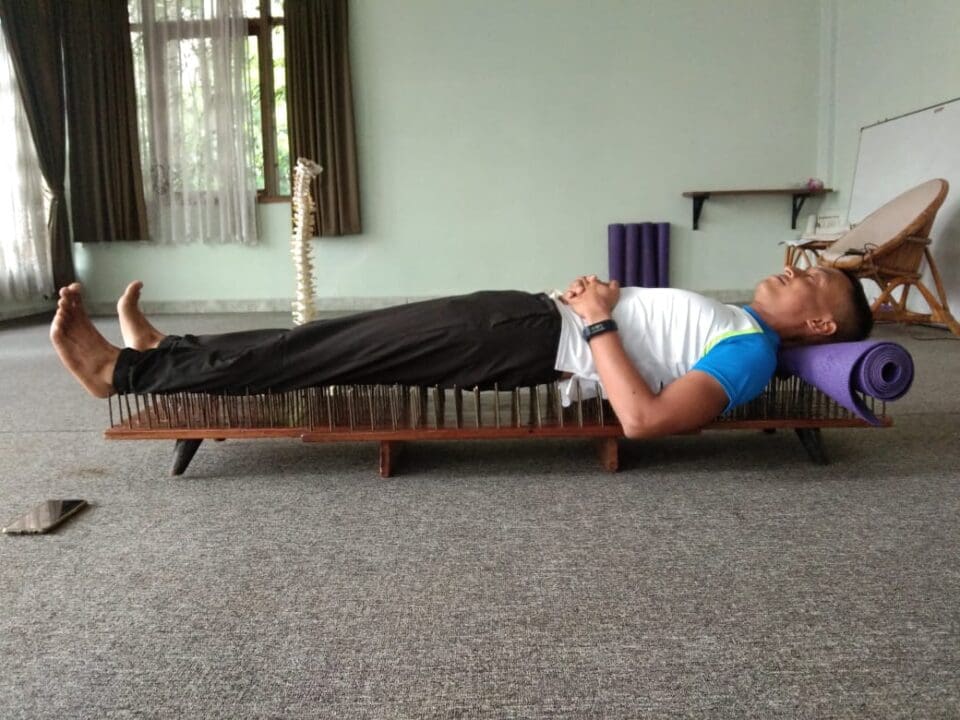
Think of your compositional actions like a bed of nails and the composition process like laying on that bed.

When your pressure is spread across hundreds of nails, you can lay (relatively) comfortably without injuring yourself. But if you place all your pressure on one or two nails, you WILL hurt yourself.

Likewise, any given 20 minutes of composing cannot support the full weight of your artistic ambitions. If you try to force it, you will injure yourself emotionally.

We’ve all been there . . .

The Process Keeps You Safe

It was never the pressure you placed on yourself that took you from blank page to finished score, because that pressure represents an aspiration or a psychological drive.

Aspirations and drives are not behaviors. They are stories. They cannot do anything.

So, second, trust the process.

Most music you write will take at least 5 hours to complete. That time span represents at least 15 composing actions.

If you do even one composing action today, it will likely have dozens, if not thousands of fellows.

So just choose one and do it.

Every action you take will help you understand your piece better. The results of any single action need not be visible in the final product.

In time, all your little actions will add up. They always do.

“But,” you protest, “That’s not inspiring! Doing some arbitrary behavior feels pointless. How can I know which compositional behaviors I should do next?”

Stay tuned. That is the subject of my next post.

Posts navigation

1 2 3 4 5 6 7 11 12 13
Scroll to top