

Open post

Inherent Vice — in Music

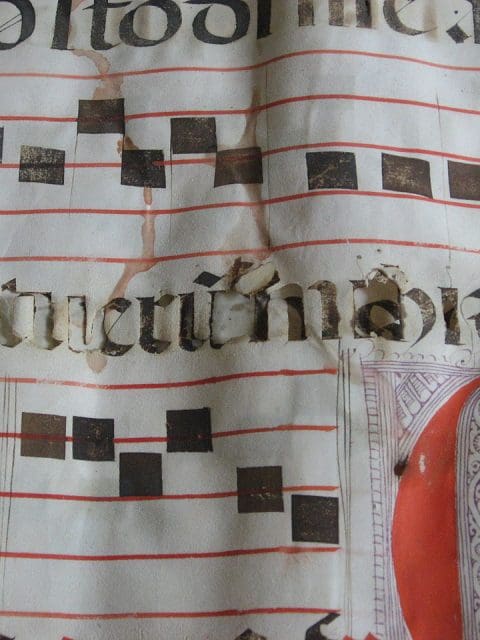
The ink erosion in this chant manuscript is an example of inherent vice.

“Inherent vice,” says Wikipedia, “is the tendency in physical objects to deteriorate because of the fundamental instability of the components of which they are made, as opposed to deterioration caused by external forces.”

As a property of physical objects, this is why certain papers and films last longer than others. It also is why materials deteriorate the way they do.

But what interests me about inherent vice are its potential musical analogies. Here a few examples of how inherent vice can be recreated in music.

Fred Rzewski: Les Moutons de Panurge

Rzewski makes it easy for performers to get lost, and in the score, he explicitly directs the performers that “if you get lost, stay lost. Do not try to find your way back into the fold.” The analogy to inherent vice is pretty clear: the piece will fall apart. What’s fascinating though is how Rzewski repurposes this as a virtue. Thus, the title feels to me like a humorous reference to Isaiah 53:6: “All we like sheep have gone astray.” (To my ears, there is no obvious reference to Handel’s setting in Rzewski’s piece, other than a general, wandering melodic contour.)

Alvin Lucier: I Am Sitting in a Room

As with Rzewski’s piece, the inherent vice of Lucier’s musical-acoustic scenario is the desired outcome. Here, the vice comes not from confusing the musicians, but from harnessing the result of rerecording the same speech, repeatedly, which gradually washes out the speakers voice and reveals the acoustic resonance of the room in which it is performed. The overall process and result feels like a metaphor for merging with the universe and reminds me of the Buddhist doctrine of anattā.

Michael Gordon: Gotham, Part III

The third part of Michael Gordon’s Gotham undergoes a similar process, albeit composed out and for orchestra. I find fascinating the different textures that he teases out of having the violins initial line unravel. Inasmuch as the process is composed out, rather than a result of the score’s execution, I wouldn’t consider the vice here to be as “inherent” as Rzewski’s or Lucier’s pieces. It’s more like “predestinated vice”: the composer decided the piece would gradually fall apart, so he ensured that it happens.

Open post

The World’s Ugliest Music? Nice Try . . .

So Dr. Scott Rickard thinks he’s composed the world’s ugliest music using fancy math.  I’m not convinced, but you can hear for yourself: the piece, written for piano, starts at 7’48.

Rickard is not the only one to use fancy math to write music. Most notably, Iannis Xenakis beat him to the punch nearly sixty years ago. Nor is it the only piece to rely on chaos to make itself unpredictable. Alvin Lucier’s  “Music on a Long Thin Wire” does that pretty well, too. In both Xenakis and Lucier, there’s an elemental beauty I find attractive (even though I wouldn’t want to listen solely to their work), and Rickard’s new work, I would argue, fits in that vein—that is, making music out of non-musical processes.

Concerning Rickard’s “pattern-free” claim, that’s certainly true if you’re looking for motives, but Mr. Rickard clearly hasn’t read Meta-Hodos (in addition, at 6’12, to misrepresenting Schoenberg’s motivation in creating the twelve-tone method. Fail.). Try as he might, he can’t de-musical-ize music. As Tenney explains, because Rickard’s materials are differentiated, relationships inevitably emerge. The most simple of these inadvertent relationships is agogic accent. While the piano piece has no definitive melodic cadences, it does have clear clusters of events, the boundaries of which are determined by the longest note in a local area. To my ears, it sounds like a series of elided phrases. Another set of relationships emerges because of the clear differentiation of registers. Particularly at the extremes of register, you hear a sense of interrupted continuity. The notes group themselves because they sound similar with respect to pitch-height. To put it simply, “random notes” can never sound random.

That said, even though I hear musical patterns within the texture, I don’t think these relationships are nearly as important as the overall sweep of the piece—in the same way that, although you can segment a performance of “Music on a Long Thin Wire,” the segmentation of it isn’t really the point. In fact, I would say that Rickard was actually quite successful in creating a work in the “acoustical positivist” vein. In both the Lucier and the Rickard, the sum texture, incorporating all internal variation, is the music. What makes such works beautiful is that even though they are, in effect, static objects, you don’t experience them statically. Only on reflection do you realize, “Wait, this is all of a whole.” There’s a serenity to such music that’s quite similar to listening to a stream or the wind (a comparison that, if I remember correctly, Lucier himself makes).

Now, if you really want to write an ugly piece of music, your best bet is to go the route of tedium. The careful use of repetition gives you a far better foundation with which to defy expectations and create a perpetual sense of anticlimax. Throw in some bad voice-leading and gratuitous dissonance, and you’re on your way. Incidentally, another group of scientists did something like this, although they approached the effect on a tangent.

Also incidentally, I really need to go to bed. So good night.

Scroll to top