When people ask, I often hem and haw about my favorite this or that. I have many movies, books, songs, and so on that I like, but I can rarely rank them.
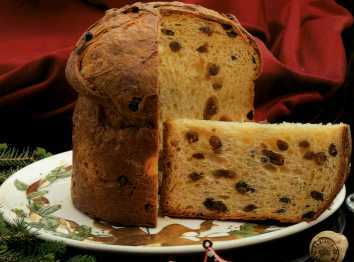
It’s not a fruit, but of everything mentioned in this post, panettone is my most favorite.
This week, though, I found a clearly rank-able category: My four most favorite fruits are
Watermelon,
Grapes,
Clementines, and
Canned apricots,
with apples and pears receiving honorable mention.
To all those who have bemoaned my inability to pick favorites, there you have it.
P.S.—I also lovepanettone. It has fruit in it . . .
Today I wrote music . . . while listening to other music. Though a first for me, this isn’t too unusual. One of my friends routinely writes music at concerts; my teacher admitted to writing one of his best pieces will at a friend’s recital; and I’ve even heard rumors that Luciano Berio wrote his Folk Songs while watching TV.
Gonzo and Fozzie demonstrate their skills at patting their heads and rubbing their stomachs in the dark room scene of The Great Muppet Caper.
Yet up until now, the idea of writing while listening to something else seemed weird to me, like simultaneously patting your head and rubbing your stomach. How could you write music and listen to different music at the same time? Writers certainly can’t do it. Imagine trying to write an essay while simultaneously reading Dickens. Though artists look at external objects all the time while they’re painting and drawing, they usually look at their subject, not, say, at a Jackson Pollack while painting a landscape. Why then does composition allow this unique multitasking?
I think it has something to do with the way our minds process music. Everyone is familiar with what it’s like to get songs stuck in their head. To non-musicians, it seems natural that composing an extension of this process. Composers simply listen to the music inside their heads and write it down. While many composers do say they write that way, if taking dictation from their earworms were all they were doing, it would seem to be as difficult for a composer to write music while listening to it as it would be for a writer to write while reading.
Instead, as I was composing today, I noticed that I was using multiple facilities. With one part of my brain and with my body I was processing the music I was listening to, and with another part of my brain, I was composing. The part that was composing wasn’t imagining sounds aurally but by feel. It was paying attention to what the harmonic and rhythmic relationships felt like rather than what they sounded like. After this experience, I happened to run into my aforementioned friend who confirmed that he experienced simultaneous listening and writing the same way.
What does this all mean? I’m not quite sure yet, only that composing is now more mysterious tonight than it was when I woke up this morning.
As promised, in this entry I’ll finish off the survey of books I’ve read this summer. I’ve had a few good ones sneak in toward the end, and I’m excited to tell you about them.
The very first book I read this summer was C.S. Lewis’s novel Till We Have Faces. The book takes place in pre-Christian Europe and is a retelling of the myth of Cupid and Psyche. A few months later, I picked up another book by Lewis, this time his classic The Great Divorce. As a Christian, I found the book to be a moving and insightful fictionalization of people’s reactions to grace. Though I enjoyed both, Till We Have Faces had a stronger impact on me and, of the two, has a more universal message.
Growing up, I had the complete Sherlock Holmes short stories, read them, loved them. Incidentally, from this memory, I decided the new movie didn’t look a thing like the books I loved, so I still haven’t seen it. I did, however, read a couple of Arthur Conan Doyle’s Sherlock Holmes novels this summer: first A Study in Scarlet then The Hound of the Baskervilles. Though it was fun learning where Sherlock Holmes and Dr. Watson came from and how they met, I found the first book to be uneven. The second book, was fantastic. In it, Doyle tells the story of a crime eerie enough to be suspenseful, but not so much to be creepy. (I find the bizarre fascinating, but I can’t stand the viscerally creepy.)
Overall, I’d say that my favorites from the summer were Till We Have Faces,The Hound of the Baskervilles, and Ender’s Game. Tomorrow, a new semester begins, and with it, I will sadly no longer have time to read three or four novels a month.
Whenever people find out I’m a composer, they first ask, “What kind of music do you write?” for which I have yet to come up with a good answer. “Instrumental” and “classical-ish” are my usual responses. The next comment they make is often “I could never write music.”
From what I can tell, many people are under the impression that music just “happens,” like falling in love Disney-style or catching a cold. Zapped by inspiration or transported by emotion, the composer pours out his soul over the keyboard, and soon a new piece of music is born. Not so. For all you who feel they could never write music, I hope to demystify the process somewhat. And to help you understand this, let’s talk about football.
A football team would never dream of walking onto the field and hoping that winning plays would just “come to them.” (Image from directsnapfootball.com)
Next Saturday, BYU will kick off its football season against Washington in what will likely be an emotional rematch, after an excessive celebration call lost Washington the game two years ago. (I’m excited for this year’s game and season!) Now, no one expects that either team will show up on the field without any preparation, physical or strategic. Particularly with strategy, the last thing a football team would dream of doing would be walking onto the field and hoping that winning plays would just “come to them.” So, plays are created and drilled in advance. Their application in the game is flexible, but their existence allows both teams to better meet the demands they’ll face.
Likewise, when I begin a piece, I have dozens of options about how to organize the melodies in the piece—when to present which one, for how long, in what key, and so on. Awareness of all these options means I can’t just plop down at the piano and let the music mystically “flow through me.” Like a football team preparing for a game, I have to make many decisions in advance. Though my compositional “game plans” are often technical (and thus obtuse to most people), there’s nothing mystical about them. After establishing the piece’s rhetorical situation and my performers’ abilities, I identify the technical means suited the situation (the length of the piece, its textures, harmonies, etc.) and choose from among them.
Once made, these decisions—my pre-compositional game plan—give me the tools necessary to fill the needs of the music I write. If I become puzzled about a particular melody or harmony, my game plan will suggest ways to resolve the conundrum. Sometimes it works the other way, too, and melodies suggest ways of enriching the game plan. Again, this is like football. Having planned plays can answer the question of how to get out of tight spots, but observing what the other team is doing—for instance, always throwing to the left or something—can also suggest ways of enriching a team’s strategy.
The moral of the story is, if you understand how the creative process works in football, you understand pretty well by analogy how it works in music. Or at least how it works for me.
My Dad’s in town this week, and it being summer, we wanted to go swimming. Only thing is, he didn’t bring a swim suit, so he, my siblings, and I all went shopping for one. Three stores later, he found a simple red one.
In the process of looking for said swim wear, my brothers and I got distracted by the tie sections in Ross and TJ Maxx. We all served missions, and after two years during which the tie you wear is your only outlet for expressing personality, you get a taste for ties. Naturally, then, we were curious about what was in fashion these days.
1st Runner-up: The “Multi-stripe”
Were we ever surprised: the ties were hideous. And it wasn’t just a few. It was most of them. They were the kind of ties you’d dig up at a secondhand store—only these were new. While I could show you many examples of the awfulness, I thought I’d limit it to three runners up and the hands-down winner.
2nd Runner-up: The “Fish”
First runner-up (left): This beauty chalks its hideousness up to an awkward pattern and color. Instead of being a classy diagonal stripe tie, it tries to be multiple diagonal stripe ties—all in the same tie. To add to its gauche, the monochromatic shadings of purple and gray are more drab and nausea-inducing than they are subtle and refined.
3rd Runner-up: First encounter ...
Second runner-up (right): Speaking of nausea-inducing, this blue and pink fish-scale-esque tie is downright dizzy-ing. Which way is the pattern going? What exactly is the shape of those scales and what’s with the black dots at the end of them? Its attempt to replicate the fish-inspired aesthetics of Gehry’s Guggenheim Bilbao museum simply crashes and burns.
3rd Runners-up: The “Sick Siblings”
Third runners-up (left and right): Admittedly, ugly fish tie was hard to beat, but we found a challenger in this retro-styled Pierre Cardin. Of all the ties we found, this one screamed “thrift store escapee.” Here was a tie so plain ugly that in any Mormon mission it would have become a posterity tie.
. . . then we found its siblings. Apparently, having one “sweet spirit” of a tie in gold isn’t enough—it also needs to exist in pink and purple. It was as if Pierre Cardin took a cue from the ice climbers in Smash Brothers. And while this discovery seemed to be top off the day, nothing could have prepared us for what we would see next.
Grand Prize: the Ugliest Tie
Grand prize: These days, the skinny black tie is coming back into fashion, and I can respect that. A good, skinny black tie projects “smooth” and “hip.” At first glance, the tie to the right fits the bill, yet on closer inspection, it has so many things going wrong.
Vinyl? Are you serious?
While the photo to the left makes it look normal, when I first saw it, I was baffled. It looked like a cross between a belt, a table cloth, and a bicycle inner tube. The thing was made out of a single sheet of vinyl. It didn’t sit flat and felt slippery under your hands. It was, in a word, repulsive.
Now none of us were sure what caused this recent bout of senseless neck ware design. All we could conclude was that right now is not a good time to buy ties. Gentlemen—consider yourselves warned.
I received word just yesterday that my proposal to write a piece for Eric Hansen, Skyler Murray, and Scott Holden—all fabulous musicians—was accepted by the Barlow Endowment, who awarded me a grant to write a 15–20 minute piece for bass, saxophone, and piano. Seeing how the endowment has given grants to a couple dozen Pulitzer Prize winning composers, in addition to commissioning a Pulitzer Prize winning piece, this commission is kind of a big deal. It’s also my first. So between all these things, I’m pretty excited.
“So what,” you may ask, “are you thinking of doing in this new piece?”
Good question. Though I don’t yet have any specific musical ideas, I have already identified what expressive resources the instruments offer. (This is how I start every piece I write, by exploring what the instruments can do.) Though I’ve written before for sax and piano, I haven’t written anything for solo bass. In studying what it can do, I was surprised to discover that, as a solo instrument, it has a strong, articulate tenor range. If that sounds surprising, go listen to the Bach Cello Suites transcribed for solo bass, in which the instrument sounds like big, resonant cello. I’m eager to explore the possibilities here.
In addition to determining my expressive resources, I’ve also begun to get a sense for the piece’s shape and feel. It’ll be in five to seven short movements, each with a different character, though all meditating on change, loss, surprise, and imagination. And unlike my orchestra piece, this time I already have a title in mind: “Book of Imaginary Beings,” after the book by Borges (with which, apart from having the same title, it will have no relation).
So now, with a commission behind these preliminaries, I’m excited to get started!
As the end of summer draws near, it’s struck me what a great summer it’s been for reading. Not only have I had ample opportunity to read new books, but I also found a whole bunch of winners in different genres. Today, I’ll start by reviewing the sci-fi/fantasy books I’ve read. In future posts, I’ll tackle some of the other genres.
I can’t remember the last book I had read by Isaac Asimov, only that I liked it and that I read it in middle school. While poking around the library’s sampler collection, I stumbled onto his Foundation Trilogy. Granted by now it’s a whole series, but I decided to stop at the end of the original trilogy. The series is pretty much a fictionalization of the Decline and Fall of the Roman Empire <corny radio voice> in space! </corny radio voice>. The books are written as strings of short stories, stories that become progressively longer from book to book, until in Second Foundation, there are only two. I found the books to be good, quick reads, and at first I thought, “Why don’t they make this into a movie?” But around the time I found out that someone had similar thoughts, I decided that it probably wouldn’t work too well. The fragmented narrative works fine in book form, but would be difficult to translate into the big screen. And with Roland Emmerich directing, you may want to read the books now before they get spoiled.
The first time I remember hearing about Ender’s Game was as a freshman in college, when my friend Dani told me it was her favorite book. I tried reading it then, but for some reason, couldn’t get into it. Now, six years later, I’ve finally read it, and I loved it. Briefly, the book takes place in Earth’s future. Humanity has been twice confronted by a mysterious alien race and is now preparing for a third invasion by training children to become military geniuses. One of these children is Andrew (Ender) Wiggin. The book follows his progress through battle school up until he passes his final examination. As with many sci-fi books, the series goes on from there, but as with Foundation, I was content to end at the ending. What makes the book great is Orson Scott Card’s ability to get you to care about the characters. Even though there’s a lot of action and excitement, the book is about people and relationships. More than being awed by technology and space battles, you can read it and say, “I’ve felt that.” I liked all the books I read this summer, but this one is in my top 3.
I remember as a kid watching the cartoon version of The Hobbit, it’s folksy music and occasional cheesiness. Around the time, I started into The Lord of the Rings, though I don’t think I even made it out of the shire it moved so slowly. On picking The Hobbit up this summer, I was pleased that it moved much more swiftly than I remember it’s counterpart did. The story of The Hobbit I expect is familiar: a hobbit, Bilbo Baggins, goes with a bunch of dwarves and the wizard Gandalf to retrieve the dwarves’ treasure from the dragon Smaug. They have various adventures along the way, including Bilbo’s discovery of a magic ring that lays the foundation for the ensuing trilogy. My thoughts? It was a fun read with lots of adventure. I also appreciated how Tolkein took time to make the world of Middle Earth real without getting lost in it himself (as I remembered him doing in the Lord of the Rings).
Over the next few weeks, I’ll write about some of the other books I’ve read. Until then, if you’re looking for a good book, I’d recommend any of the above. Particularly if you like sci-fi/fantasy. (Though if you do, you’ve probably already read these.)
So BYU has a reputation of having a great dance program. In fact, its top team won two firsts at this year’s Blackpool Dance Championships. Since good number of my friends are also involved in the dance program, it was only a matter of time before I decided to take the plunge.
Actually, I already plunged six years ago when, as a freshman, I took the obligatory Dance 180 (“Social Dance”). As my first ballroom experience, I fumbled through and somehow got bronze level certification, even though I was pretty certain that dance was beyond me. One mission and four years of undergraduate degree later, I decided it was time to have another go, and accordingly signed up for Dance 280. In the intervening years, the occasional dancing I’d done convinced me that now I did not have two left feet, and maybe only one and a half.
So this term I am taking “Social Dance 2,” and as I had expected, things actually have begun to click . . . mostly. The class is going just at the edge of my being able to keep up. Most of the time, it’s all I can do to learn the steps let alone apply the technique. The other day the TA came up to me and the girl I was dancing with and suggested that we try to dance in more masculine and feminine ways respectively. Right now, he said, we were dancing too neutrally. He showed us what he meant, and I might have noticed some slight difference, but mostly I thought to myself, “Mr. TA, I’ll accept the compliment that you seem to think I have enough control over what I’m doing to make that difference.”
That was cha-cha. When it came time to take the test, I did okay, though I had only negative (though valuable) feedback on my test sheet. With that, we moved on to triple swing. I think dancers need a translate function, too. There’s one step we were doing, called the “windmill,” that took me forever to figure out. The step involves leading the girl around you, kind of like a windmill. In the mean time, the guy is supposed to rotate himself while triple stepping. I couldn’t wrap my feet around how to do that nor could any of my friends or instructors point me in the right direction (though they tried). Finally, I sat out watching the rest of the class as they did the step until I realized, “That’s what I’m doing wrong!” (I’m not even going to try to describe it.) Then all the advice I’d been given suddenly made sense.
So today we tested swing, and this time there was a positive comment among all the “too much back lean” and “occasionally shuffling”: “You’ve improved a lot since cha-cha.” There it is, folks: I’m moving up in the dance world, one comment at a time. Mostly, I think I’m beginning to learn how to translate dancer sense of space and rhythm into a musician sense of such.
The BYU Philharmonic will be performing my piece “Summer Has Ten Thousand Stars” in a bit less than two weeks, on April 10 at 8:00 p.m. The concert is part of a celebration KBYU is having for its 50th Anniversary. For more information about the concert, visit here.
Sometimes I write music “about” something. Other times I simply write music. My recent orchestra piece was one of those latter times. All the while I was writing it, I struggled to come up with a title. Even after completing the piece, two revisions later, and after having distributed the parts to the musicians, I still didn’t have a title for it. It was simply “Orchestra Piece.” I had an idea of what the music meant to me—life, light, energy—but I couldn’t encapsulate these feelings into words. Among my initial rejects were “It’s a Magical World” (the title of the first draft), “Sunflower,” and “Bodies Celestial.”
Wordsworth's poem neatly combined two images I had about the music: flowers (specifically daffodils, as seen above) and stars.
In the midst of this struggle to devise a title, one of my friends suggested that I look through some of her poetry books. I went through several, copying down lines I liked and mashing them together until I came up with a title that felt right: “Summer Has Ten Thousand Stars.” It fit, and that was the end of the story. I didn’t bother to remember what the poems were.
Or so I thought. This morning as I was sorting through my papers, I found a copy of Wordsworth’s “I Wandered Lonely as a Cloud” dated from February 2008. At first I didn’t recognize the poem until I came to the lines “Continuous as the stars that shine / And twinkle on the milky way, / . . . Ten thousand saw I at a glance” (emphasis added). Suddenly, I realized, “Hey! This is that poem I used to come up with the title for my orchestra piece!” I was quite surprised. It would seem that this image has been sitting with me for the last two years, waiting to be rediscovered.
(As for the “Summer Has” part, I looked it up: It’s from Dickinson.)